Filling Materials
What is a Filling Material?
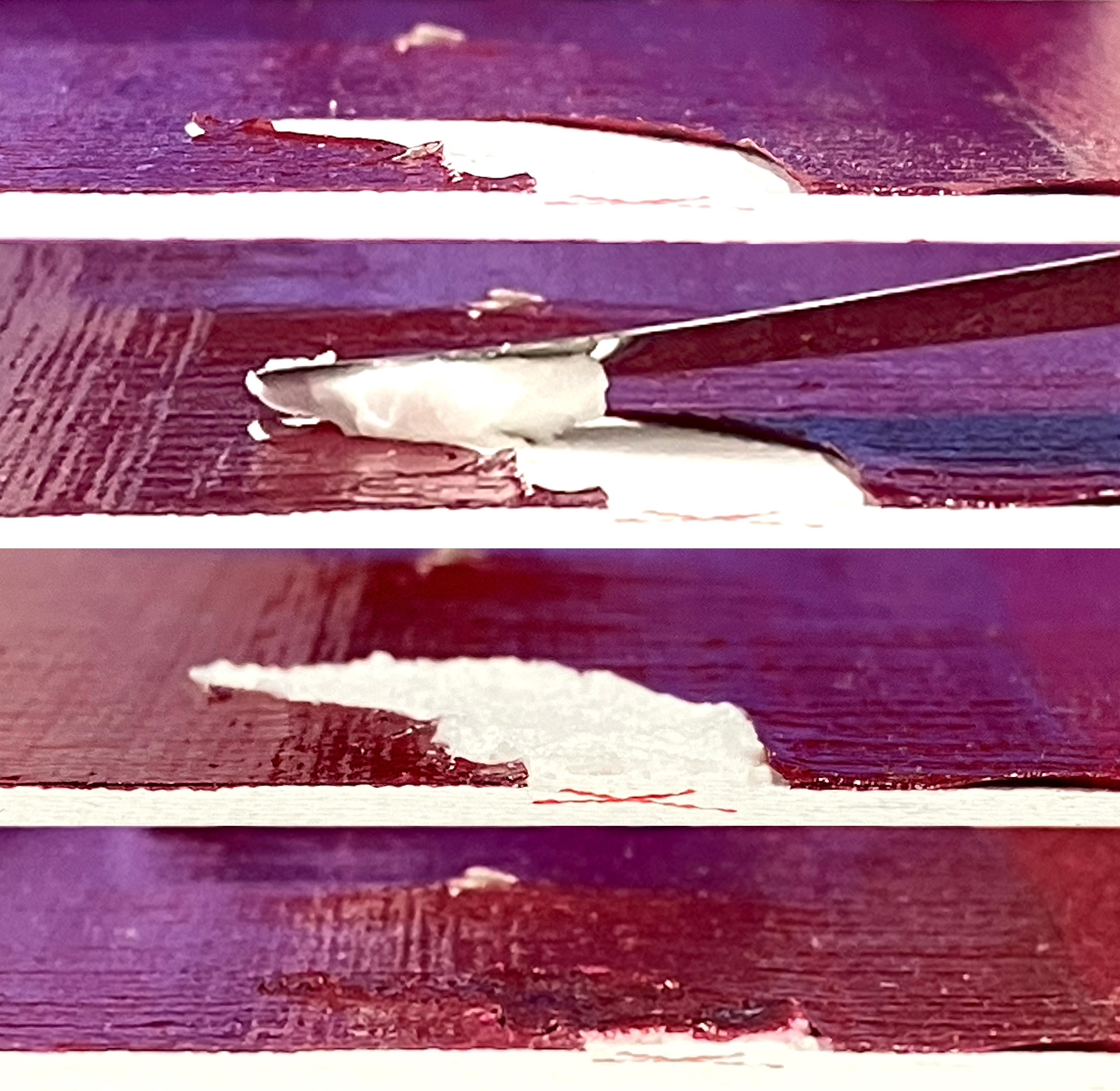
1. Hole in the painting.
2. Using a palette knife to fill the area with a lightweight commercial paste.
3. Smoothed down and tried to recreate the brushstrokes of the surrounding paint film. Used a Q-tip and water to clean around the edges of the area. Allowed to dry.
4. Thin layer of isolation coat to lower the porosity. Allowed to dry. Painted over with Aquazol-based watercolor in the same color.
When there is an area of loss in a painting, a conservator will apply a removable ground to that area, filling in the topography and mimicking the surrounding texture. The conservator can use a commercial product or mix their own filling material based on recipes in conservation literature. Then, once this layer is dry, they can inpaint with the proper color to create the illusion of a continuous surface. If the conservation work needs to be undone in the future, e.g. if the retouch color no longer matches, a gentle solvent can be used to remove the overpaint without damaging the original paint.
Commercial Options
There are many commercial filling materials designed for purposes other than paintings conservation, e.g. wood filling, that conservators have found to be suitable and versatile. Materials could be putties or pastes or thin gessoes, depending on the demands of the particular painting, and they can be water-based, solvent-based, or wax-based, though epoxy can also be used in some instances.1 They can be white or tinted with pigments to better emulate the original ground color or provide a closer starting point for inpainting. The filling material should be compatible enough to have good adhesion to the area being filled but be chemically distinct from the original materials so that removing the conservation treatment in the future would not remove original work.2,3 Usually, it is beneficial to apply an isolation layer of varnish before applying the filling material, which helps with cleaning away excess filling material with a Q-tip and with future reversibility.3
In early 2025, I visited a conservation studio and saw a container of “Modostuc,” looking like spackle, at one of their workstations. They were inpainting Modostuc as a retouching ground on several oil paintings. The paintings had little white dabs of filling material over the areas of loss around the edges, where the paintings had been abraded by contact with the frames. They told me they could use Modostuc to emulate any kind of paint texture – just add water to the desired level. This white filling material would later be painted over with the appropriate color in a medium dissimilar to the original paint materials. For an oil painting, they might use watercolor or mineral spirit acrylic, whichever paint finish would best match the painting.
Water-Based
Modostuc (available)
Laura Fuster-López, in her chapter “Filling” as part of the book Conservation of Easel Paintings (2020), writes that “Modostuc is used worldwide by conservators due to its porosity and optimal handling properties as well as its receptivity for casting textures, mechanical tooling, and compatibility with aqueous retouching systems,”3 corroborating what the conservator told me. Fuster-López notes that this porosity can make retouching with watercolor too matte, as the paint sinks into the fill, so it is beneficial to apply a layer of varnish, such as Paraloid B-72, over the fill as an isolation layer to reduce the absorbency.3
Museum Service Corporation, a retailer, describes Modostuc as “a dense putty material with very little shrinkage after drying…a PVA binder with calcium carbonate filler. It can be thinned with water, ethyl alcohol or acetone…If Modostuc dries out, it can be revitalized by adding more water. Compatible with wood, stone, ceramic, porcelain and other substrates.”4 Talas, another retailer for conservation supplies, describes the product as a filler for wood restorations that can be varnished over, and they provide an SDS that lists 1.3-3% polyvinyl acetate binder, some glycol ether and preservative, and 76-78% inert material, which refers to the solids.5
Sabine Kessler’s 1997 objects conservation thesis looked at Modostuc’s reversibility and analyzed its composition, while acknowledging that the supplier could change the prodcuct’s formula at any time, as 23.65% weight water; 69.7% fillers – majority calcium carbonate, minority barium sulfate, and trace amounts of silica, aluminum, and iron; 6.65% binders – majority polyvinyl acetate and minority polyvinyl versatate and polyacrylic; and bis(2-ethylhexyl) phthalate (DEHP) as a plasticizer.6
Phthalate plasticizers are known to leach out and/or evaporate over time,7,8 and they were removed from polymer clays, e.g. Sculpey, due to endocrine disruption concerns by 2009.9 If the product has been reformulated since then, which is likely in the ever-changing regulatory landscape, it is possible that they have switched to a new plasticizer.
Polyvinyl acetate binders are cleanable with alcohol or mineral spirits, which would typically be considered safe to swab over an old oil painting. Kessler found that after one month in a 40 °C (104 °F) oven, which should allow almost all residual water to evaporate, Modostuc was still removable with water, but she did not conduct a longer term study.6
Flügger (discontinued but still available from some retailers)
Another “spackle” that conservators like is the now-discontinued “Flügger.” Flügger is similar to Modostuc, except that it has an acrylic binder instead, and conservators like its smoother texture.3 Like Modostuc, it was not developed for conservation purposes but was a product that conservators happened to test and find suitable.
Though acrylics are not typically resoluble with water once dry, only a small amount of binder is used, just enough to promote cohesion of the film and adhesion to the substrate, so an aggressive approach should not be required to remove them. The material will be inherently more water-sensitive since it is “underbound.” A coating that contains a much higher level of absorbent solids like chalk than it does binder will be susceptible to removal by solvents like water. Because these filling grounds are so high in solids, they do not shrink much when they dry, so they can hold impasto brushstrokes and emulate a variety of textures.
Other Commercial Products
Conservators have found water-based molding pastes made by art materials manufacturers to be suitable, but since these are designed for artist use, they are not designed to be reversible and, like other commercial products, are subject to formula changes at any time without notification. As a formulator at Golden Artist Colors, I can tell you that we have not tested Molding Paste (which I have seen recommended) as a conservation fill, and formulations certainly change over the years, whether it is due to raw material discontinuations, regulations, or optimization (use at your own risk). Our gels, pastes, and mediums are not designed to be removed, but as water-based acrylics, they certainly are susceptible to removal by alcohol and acetone solvents. So, a fresh container of filling material ought to be tested for its reversibility, working properties, durability, cracking, and UV stability before use in a conservation treatment. Fuster-López speaks to the problematic nature of commercial options: “The absence of information regarding composition, ageing, and interaction with the work of art is not consistent with standards for the use of conservation materials and thus may pose some concern.”3
For more commercial options, see Fuster-López’s “Filling” in Conservation of Easel Paintings (2020) and van den Burg’s and Seymour’s Filling Losses in Paint: Paintings Conservation, where they each discuss a number of commercial filling materials suitable for painting conservation.
Wax-Based
A historical filling approach was to use mixtures of lead carbonate and drying oils such as linseed oil in order to best replicate the surface of the original painting, but this treatment was permanent and not reversible, as the oil would crosslink to the adjacent paint, and the lead white pigment could migrate. Lead white, however, shows up well in x-radiographs, so the fillings could be easily identified through future analysis.1 After lead fell out of favor in the 19th century, wax-oil or wax-resin-oil mixtures. Like the lead-oil fillings, due to their oil binder, the wax-oil fillings were indistinguishable from the original oil paint and therefore nonremovable, apart from through mechanical removal like cutting, scraping, or drilling.1,3 If natural resins, such as dammar, were included, they too were likely to crosslink and no longer be removable with turpentine as they aged.
Today, wax, which itself is resoluble in mineral spirits, is still used as a filling material, but conservators would not choose an oil binder, but rather a synthetic binder soluble in mineral spirits. An advantage of a wax fill is its ability to flow into the area of loss when melted, leveling to a smooth surface for retouching, or, alternatively, being manipulated to imitate brushstrokes.
Gamblin’s Pigmented Wax/Resin Sticks are based on beeswax, microcrystalline wax, and Laropal A-81, a synthetic resin which is soluble in aromatic solvents.10 The stick can be heated with a dental tool or a heated palette knife tool so that it can be applied to small areas of loss. A conservator could make their own wax-resin filling material, since all they would have to do would be to melt the wax and the resin together and add pigments, if desired, but Gamblin’s sticks provide the convenience and elegance of a manufactured product.
Conservator Recipes
Since products can be reformulated at any time, a product that may have worked before may not necessarily continue to work in the future. It would be more ideal for conservators to be in control of the formula, where they could use a filling material that did not contain plasticizers, as they could migrate into the original painting, or other additives with unknown archival properties. They also could document the exact composition of filling material used to aid future conservators in the removal of this conservation work down the line.
A traditional formula mixed by a conservator may still use animal hide glue as the binder, in order to closely match the original ground, but such a filling material will be susceptible to humidity changes and, while rigid, may not be strong enough to stand the test of time (though, synthetic materials can also have these drawbacks, especially PVA that does not age well in UV).3 A conservator may add a synthetic binder to a hide glue filling material to promote adhesion.3 More and more, synthetic binders like Aquazol (poly(2-ethyl-2-oxazoline)) and Mowiol (PVA) are substituted for hide glue since they are stronger adhesives and since they can be resolubilized with solvents other than water (though they are also soluble in water).3
Due to the simple formula of something like Modostuc or Flügger, it is possible for a conservation studio to make their own similar filling material, but certainly a ready-to-use product is more cosmetically elegant and more straightforward than is making your own paint, and likely cheaper, as well. As paint-making is its own profession, it is less crucial for conservators to be experts in such. It would also be possible to work with a manufacturer to get a custom product made, where conservators would be privy to the exact composition of the filling material, but that would be the most expensive option.
Julia van den Burg and Kate Seymour provide some tested recipes in their brochure, Filling Losses in Paint: Paintings Conservation for the Cultural Heritage Agency of the Netherlands. The recipes consist of inert solids, like calcium carbonate, water or ethanol as solvents, and various binders.The following can be employed to thicken the filling material into a putty or paste.
| Bulking Agents1,3 | ||||||
| Calcium carbonate | Aka chalk, limestone dust, marble dust, and more, calcium carbonate is cheap and ubiquitous, offering some white opacity. | |||||
| Calcium sulfate | Aka gypsum or Plaster of Paris, calcium sulfate is also cheap and ubiquitous, and it expands on drying due to chemical reaction, which helps to counteract shrinkage from water or other solvent evaporation. | |||||
| Barium sulfate | Heavy, white pigment with good hiding power, or, as blanc fixe, white to translucent solid, cheaper than titanium dioxide. | |||||
| Talc | Translucent with platy structure that makes a smooth finish. | |||||
| Kaolin | Aka clay, a platy solid that is typically more transparent than calcium carbonate. | |||||
| Aluminum hydroxide | Can be used as a translucent bulking material but is primarily a flame retardant, which will degrade at high temperatures such as during a fire. | |||||
| Silica | Many grades exist, transparent to whitish solid that may burnish easily. Avoid silicas containing crystalline silica, aka quartz, as they can scratch the original paint. | |||||
| Mica | A platy type of silica that is smooth and reflective. | |||||
| Glass hollow microspheres | Borosilicate glass shaped into hollow spheres are lightweight, compressible, and shrink less on drying than other bulking materials since they are non-absorbent. Because they are glass spheres entrapping air, there are additional interfaces between glass and gas for light to pass through, making these microspheres appear white in coatings. | |||||
| Cellulose fibers | Lightweight material that can add tensile strength due to the length of its fibers, but it swells in water and is permanently water sensitive. | |||||
| Cellulose ethers | Thickener with some low binding ability. If used as the sole binder, can be cleaned easily but may not provide enough adhesion. | |||||
The following binders can be used to provide cohesive strength, glue the filling material to the substrate, and plasticize the coating so that it does not crack upon drying.
| Binders1 | ||||||
| Polyvinyl alcohol | Permanently water soluble. Often used in combination with polyvinyl acetate. Abbreviated as “PVA,” “PVOH,” or “PVAl.” | |||||
| Polyvinyl acetate | Common adhesive, especially as wood glue, that is often used in combination with polyvinyl alcohol. Also (confusingly) called “PVA,” or “PVAc.” Susceptible to fungal and bacterial degradation. | |||||
| Acrylic | Usually water-based emulsions but can also be solvent-based. Minimal yellowing and cracking but films tend to be soft. | |||||
| Vinyl | Usually water-based. Yellows and cracks as it ages. | |||||
| Epoxy | Two putty parts to be mixed together to start chemical reaction. Cures by chemical reaction and must be mechanically removed. | |||||
| Aquazol | Supplied as a pellet to be dissolved and comes in different grades reflecting increasing molecular weight. A synthetic polymer permanently soluble in water and alcohol. | |||||
| Paraloid B-72 | Supplied as a pellet to be dissolved. A non-yellowing, synthetic acrylic soluble in 100% aromatics. | |||||
| Animal Glues | Animal hide gels up after boiling due to its collagen content. Forms rigid films. Water-soluble, historical material that is particularly susceptible to humidity. | |||||
References
1. Burg, Julia M. van den, and Kate Seymour. 2024. Filling Losses in Paint: Paintings Conservation. Amersfoort: Cultural Heritage Agency of the Netherlands. https://www.cultureelerfgoed.nl/publicaties/publicaties/2024/01/01/filling-losses-in-paint.
2. “Code of Ethics and Guidelines for Practice of the American Institute for Conservation.” 1994. American Institution for Conservation. https://www.culturalheritage.org/docs/default-source/resources/governance/organizational-documents/code-of-ethics-and-guidelines-for-practice.pdf.
3. Fuster-López, Laura. 2020. “Filling.” In Conservation of Easel Paintings, edited by Joyce Hill Stoner and Rebecca Rushfield, 2nd ed. London: Routledge. https://doi.org/10.4324/9780429399916.
4. “Modostuc.” n.d. MuseuM Services Corporation. Accessed April 24, 2025. https://museumservicescorporation.com/products/modostuc.
5. “Modostuc SDS.” n.d. Talas Online. Accessed April 24, 2025. https://www.talasonline.com/images/PDF/MSDS/modostuc.pdf.
6. Kessler, Sabine. 1997. “Etude et restauration d’une Jeanne d’Arc en terre cuite conservée au Musée des beaux-arts d’Orléans: étude d’un matériau de bouchage: le Modostuc.” Inp - Médiathèque numérique. October 14, 1997. https://mediatheque-numerique.inp.fr/documentation-oeuvres/memoires-diplome-restaurateurs-patrimoine/etude-restauration-dune-jeanne-darc-en-terre-cuite-conservee-au-musee-beaux-arts-dorleans-etude-dun-materiau-bouchage-modostuc.
7. “Plasticizer - an Overview | ScienceDirect Topics.” n.d. Accessed April 13, 2025. https://www.sciencedirect.com/topics/earth-and-planetary-sciences/plasticizer.
8. Roark, Alison McCombe. 2020. “Endocrine Disruptors and Marine Systems.” In Encyclopedia of the World’s Biomes, edited by Michael I. Goldstein and Dominick A. DellaSala, 188–94. Oxford: Elsevier. https://doi.org/10.1016/B978-0-12-409548-9.12426-1.
“Plasticizers are additives used in the production of plastics to reduce the attraction between polymer chains, thereby increasing the flexibility and durability of the resulting plastic. The most common plasticizers are phthalate esters…When used as plasticizers, phthalates are not covalently bonded to the polymer matrix and thus readily leach from plastics, especially when the plastics are exposed to elevated temperatures, low pH, or ultraviolet light. Lower molecular weight phthalates such as dimethylphthalate (DMP) are less hydrophobic and thus leach more readily from plastics than higher molecular weight phthalates like diethylhexylphthalate (DEHP)” (Roark 2020, 188-194).
9.Consumer Product Safety Improvement Act of 2008. 2008. https://www.cpsc.gov/s3fs-public/pdfs/blk_media_cpsia.pdf.
“(a) PROHIBITION ON THE SALE OF CERTAIN PRODUCTS CON- TAINING PHTHALATES.—Beginning on the date that is 180 days after the date of enactment of this Act, it shall be unlawful for any person to manufacture for sale, offer for sale, distribute in commerce, or import into the United States any children’s toy or child care article that contains concentrations of more than 0.1 percent of di-(2-ethylhexyl) phthalate (DEHP), dibutyl phthalate (DBP), or benzyl butyl phthalate (BBP).” (CPSIA 2008)
10. McIntyre, Christine. 2011. “Development of a Pigmented Wax/Resin Fill Formulation for the Conservation of Paintings.” Art Conservation Department, Buffalo State College.https://conservationcolors.com/wp-content/uploads/2016/01/McIntyre_695_To_Gamblin_2014.pdf